What is Answer Engine Optimization
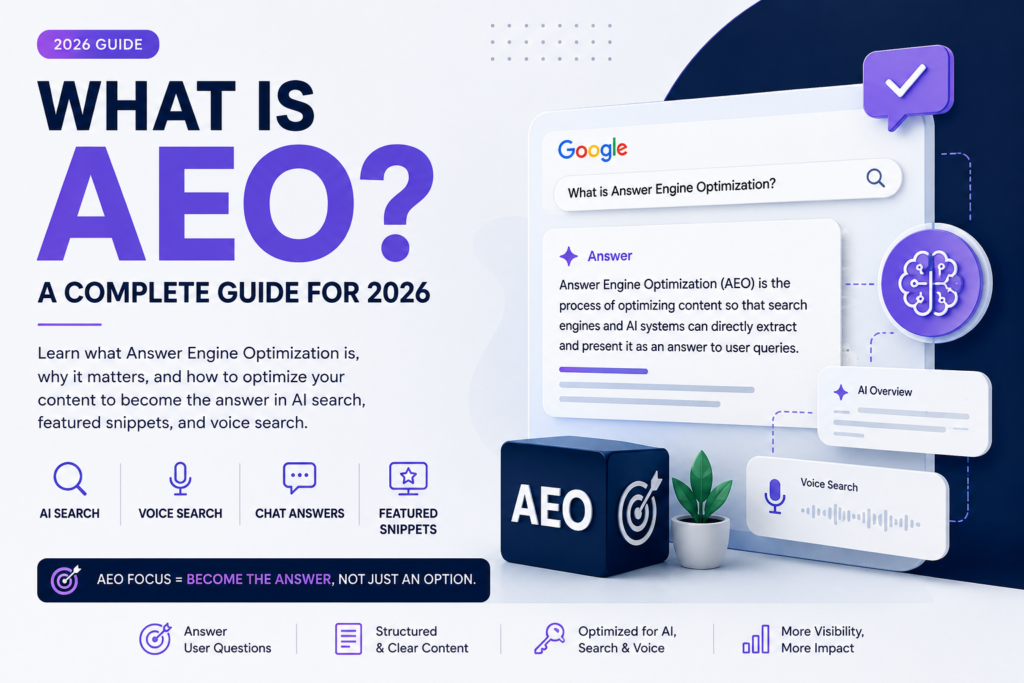
Answer Engine Optimization is the process of creating content that helps search engines and AI platforms understand and deliver answers to users. Platforms such as AI search engines and voice assistants rely on clear, well-structured content to generate responses.
AEO vs SEO: What’s the Difference?
SEO (Search Engine Optimization) is the process of improving a website so it ranks higher on search engine results pages like Google. It focuses on signals such as keywords, backlinks, page speed, and content structure to help search engines understand and rank a page. The goal is to bring users to your website through organic search traffic.
AEO (Answer Engine Optimization), however, is designed for a newer type of search experience where users often get direct answers instead of clicking through multiple websites. This includes AI-generated responses, voice assistants, featured snippets, and conversational tools. AEO focuses on structuring content in a way that allows AI systems to quickly extract clear, direct, and reliable answers.
In practice, SEO helps your content get discovered, while AEO helps your content get selected as the answer.
SEO is still essential because it builds long-term visibility and authority. But relying on SEO alone is no longer enough. As AI-driven search becomes more common, content must also be optimized for answer engines that prioritize clarity, context, and intent.
The most effective strategy is a combination of both. SEO ensures your content can be found, while AEO ensures your content can be used as the final answer. Businesses that integrate both approaches will have a stronger chance of appearing across traditional search results, AI summaries, and voice-based search systems, giving them maximum visibility in the evolving digital landscape.
Benefits of Answer Engine Optimization for Businesses
A successful AEO strategy starts with understanding user intent. Content should answer questions directly and use simple language. Structured headings, bullet points, and FAQ sections can improve AI search optimization.
To increase visibility in Google AI Overviews, marketers should create authoritative content, use schema markup, and provide concise answers to common questions. These practices help search engines identify valuable information quickly.
Best Practices for Answer Engine Optimization
Implementing Answer Engine Optimization requires more than simply adding keywords to a page. The goal is to create content that answers user questions clearly while making it easy for search engines and AI systems to understand the information.
Some of the best practices include:
- Research the questions your audience is asking.
- Write clear and direct answers near the beginning of each section.
- Use descriptive H2 and H3 headings to organize information.
- Add FAQ sections to address common user queries.
- Include schema markup where appropriate to help search engines understand your content.
- Improve page speed and mobile responsiveness for a better user experience.
- Keep your content updated as AI search technology continues to evolve.
Following these practices increases the chances of your content appearing in featured snippets, Google AI Overviews, voice search results, and AI-powered search platforms.
The Future of Answer Engine Optimization
AI search is changing how people discover information online. As more users rely on conversational search tools, businesses that invest in Answer Engine Optimization will have a competitive advantage.
By focusing on user intent, clear content structure, and AI search optimization techniques, marketers can improve their chances of appearing in AI-generated responses and search results.
Common Mistakes to Avoid in Answer Engine Optimization
Many businesses make the mistake of treating Answer Engine Optimization exactly like traditional SEO. While keywords are still important, AEO focuses on providing clear, direct, and helpful answers that AI systems can easily understand and present to users.
One common mistake is writing long introductions before answering the main question. Instead, provide the answer early and then explain it in more detail. Another mistake is using unclear headings or poor content structure, making it difficult for AI platforms to identify the most relevant information.
Ignoring user intent is another major issue. Your content should solve the user’s problem rather than simply target a keyword. It is also important to keep information accurate and updated because AI search engines prefer fresh and trustworthy content.
Finally, avoid keyword stuffing and overly complex language. Use your focus keyphrase naturally while writing in a simple, conversational style. By avoiding these mistakes, your Answer Engine Optimization strategy will be more effective and improve your chances of appearing in AI-generated answers, featured snippets, and voice search results.
Conclusion
AEO is quickly becoming a core part of modern digital marketing. As search engines shift toward AI-driven results, businesses that adapt early will have a clear advantage in visibility and traffic.
Understanding AEO helps you move beyond traditional SEO and focus on providing direct, structured, and meaningful answers to user queries. This improves your chances of appearing in AI-generated results, featured snippets, and voice search responses.
To succeed with Answer Engine Optimization, focus on clear content structure, strong headings, and intent-based writing. Use relevant keywords naturally and ensure your content directly solves user problems.
In the long term, AEO will not replace SEO, but it will work alongside it. Combining both strategies will help you stay competitive in the evolving search landscape and build stronger online authority.
To measure the success of your AEO strategy, check out The Importance of Digital Marketing in Modern Business
Leave a Reply