Whales are among the largest and most remarkable animals on Earth. These marine mammals live in oceans around the world, from warm tropical waters to the cold seas surrounding the poles.
Life Beneath the Surface
Although whales spend their lives in water, they breathe air through blowholes located on top of their heads. They must regularly return to the surface to breathe before diving again in search of food or traveling through the ocean.
Whales are warm-blooded, give birth to live young, and nurse their calves with milk. A thick layer of fat called blubber helps protect them from cold water and stores energy during long migrations.
Two Main Groups
Whales are generally divided into baleen whales and toothed whales. Baleen whales filter small animals from the water using flexible plates inside their mouths. This group includes blue whales, humpback whales, and gray whales.
Toothed whales use teeth to catch fish, squid, and other prey. Many of them also use echolocation, producing sounds and listening for returning echoes to understand their surroundings. Sperm whales, belugas, and orcas belong to this group.
The Blue Whale
The blue whale is the largest known animal to have ever lived. An adult can grow longer than a city bus and weigh well over one hundred tonnes. Despite its enormous size, it feeds mainly on tiny crustaceans called krill.
Communication and Migration
Whales communicate using clicks, whistles, pulses, and complex songs. Some sounds can travel across great distances underwater. Humpback whales are especially famous for their long, patterned songs.
Many species migrate thousands of kilometres each year. They often feed in cold, nutrient-rich waters before traveling to warmer regions where they mate and give birth.
Protecting Whales
Commercial hunting once caused severe declines in many whale populations. Today, whales also face threats from fishing gear, ship collisions, underwater noise, pollution, and changes to ocean ecosystems.
Conservation programs, safer fishing practices, protected habitats, and international cooperation can help whale populations recover. Protecting whales also supports healthier oceans because these animals play an important role in marine food webs and nutrient cycles.
The future of SEO is being reshaped by AI search. As search engines introduce AI Overviews, AI Mode, and other generative search experiences, the way people discover and consume information is changing. For businesses, this means SEO is no longer just about ranking webpages and earning clicks. It is increasingly about creating useful, trustworthy content that can be discovered across evolving search experiences.
What Is the Future of SEO in AI Search?
The future of SEO will focus less on ranking for individual keywords and more on becoming a trusted, understandable, and citable source of information across traditional search engines and AI-powered answer engines.
SEO is not disappearing. It is expanding.
Businesses will need to optimize content for both:
Traditional search results
AI-generated answers
Featured snippets
AI Overviews
Voice search
Chatbots and AI assistants
Other zero-click search experiences
The fundamental goal remains the same: help users find useful information.
The way users discover that information is what is changing.
What Is AI Search?
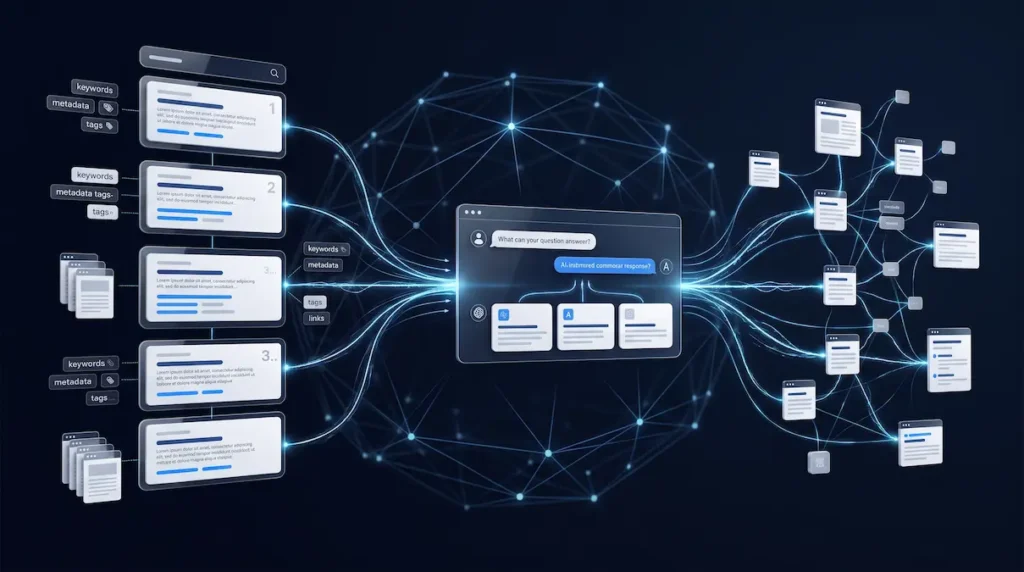
AI search uses artificial intelligence to understand a user’s intent and generate or organize an answer rather than simply displaying a list of links.
Traditional search might work like this:
User → Query → Search results → Website → Answer
AI-powered search increasingly looks like:
User → Question → AI retrieves information → Synthesized answer
This changes the role of the website.
Instead of being only the final destination, a website can become a source that an AI system uses to construct an answer.
That creates a new visibility opportunity for brands.
What Is AEO?
Answer Engine Optimization (AEO) is the practice of structuring and optimizing content so that answer engines can understand, retrieve, and potentially cite it when responding to user questions.
Traditional SEO often asks:
“How can I rank this page?”
AEO asks:
“How can I make this information the clearest and most useful answer to this question?”
AEO does not replace SEO.
Instead, AEO builds on traditional SEO principles while optimizing content for answer-driven search experiences.
SEO vs AEO: What Is the Difference?
Traditional SEO
AEO
Focuses heavily on rankings
Focuses heavily on answers
Targets keywords
Targets questions and intent
Optimizes for search results
Optimizes for answer engines
Click-through rate is important
Citations and visibility can be important
Often targets SERPs
Targets SERPs, AI answers and zero-click experiences
Page ranking is a major goal
Being selected as a trusted source is a major goal
The two approaches should not be treated as competitors.
A strong digital strategy should use SEO + AEO together.
How AI Is Changing the Future of SEO
The biggest change is the movement from searching for information to asking for information.
Instead of searching:
“best digital marketing tools”
A user might ask:
“What digital marketing tools should a small business use in 2026 and why?”
An AI search system can potentially provide a synthesized response based on multiple sources.
This creates several important changes for marketers.
1. Search queries are becoming more conversational
Users can now ask longer, more specific questions.
This means businesses should understand search intent, not simply keyword volume.
Content should answer questions such as:
What is it?
Why does it matter?
How does it work?
How much does it cost?
What are the alternatives?
Which option is best for a specific situation?
What are the advantages and disadvantages?
2. Zero-click searches are becoming more important
A zero-click search occurs when a user gets the information they need directly from the search experience without clicking through to a website.
AI-generated answers can accelerate this behavior.
For publishers and businesses, this creates an important challenge:
If users do not click, how does a brand generate value from search visibility?
The answer will increasingly involve measuring more than organic traffic.
Businesses may need to consider:
Brand mentions
AI citations
Branded searches
Qualified traffic
Assisted conversions
Leads
Revenue
Visibility across AI platforms
SEO measurement is therefore moving beyond simple rankings.
3. Topical authority will matter more
AI systems need reliable information.
A website that publishes one article about a topic may have less contextual depth than a website that comprehensively covers the entire subject.
For example, a digital marketing website could create a topic cluster around Meta Ads:
What are Meta Ads?
How does Meta Ads bidding work?
What is CPM?
What is CTR?
What is CPC?
What is ROAS?
How does Meta attribution work?
How do you install the Meta Pixel?
How do you optimize a Meta Ads campaign?
What causes ad fatigue?
Together, these pages demonstrate topical depth.
The future of SEO will increasingly reward businesses that demonstrate genuine expertise rather than simply publishing large quantities of generic content.
4. Content quality will become more important than content volume
AI can generate thousands of articles.
That means producing more content is no longer a meaningful competitive advantage by itself.
The harder question is:
Why should an AI system trust your content over another source?
Strong content should provide:
Original insights
First-hand experience
Clear explanations
Relevant data
Examples
Expert opinions
Original research
Unique perspectives
Accurate references
Updated information
AI makes content creation easier.
That makes information differentiation more valuable.
How Do You Optimize Content for AEO?
AEO should not mean stuffing every paragraph with questions.
Instead, structure content so that both humans and machines can understand it efficiently.
1. Answer the question immediately
If your heading is:
What is AEO?
Do not make readers search through five paragraphs for the definition.
Start with a concise answer.
AEO is the practice of optimizing content so that answer engines can understand and potentially use it when responding to user questions.
Then provide deeper explanation.
This creates a strong information hierarchy.
2. Use question-based headings
Question-based headings naturally align content with conversational search.
Examples:
What is AEO?
How does AI search work?
Why is SEO changing?
How can businesses optimize for AI search?
Does AEO replace SEO?
What will happen to backlinks?
How will SEO be measured in the future?
These headings also make long-form content easier to scan.
3. Create concise answer blocks
A strong AEO article should contain sections where the answer can be understood quickly.
For example:
Does AEO replace SEO?
No. AEO does not replace SEO. It extends traditional SEO by optimizing content for AI-powered answer experiences, conversational search, and zero-click results.
Then expand on the topic.
This structure helps both users and information-retrieval systems identify the core answer.
4. Use structured data
Structured data helps search engines understand the meaning and relationships within webpage content.
Depending on the page, relevant schema types may include:
Article
FAQPage
HowTo
Organization
Person
Product
LocalBusiness
However, adding schema does not guarantee an AI citation or search feature.
Structured data helps machines understand content. It does not replace content quality.
5. Build strong internal linking
Internal links help search engines and users discover relationships between topics.
For example:
SEO → Technical SEO → Schema Markup → Structured Data → AEO
This creates a connected knowledge structure.
Instead of publishing isolated articles, build topic ecosystems.
6. Demonstrate first-hand experience
One of the biggest opportunities in an AI-generated content environment is publishing information that is difficult to reproduce without actually doing the work.
For example:
Instead of:
“Meta Ads can be optimized by improving your creative.”
Publish:
“We tested three creative hooks across the same audience and found that the problem-focused hook generated a higher CTR than the product-focused version.”
The second statement contains an experience, observation, and specific context.
That is much harder to commoditize.
What Happens to Keywords in an AI Search World?
Keywords will still matter.
But their role is changing.
Traditional SEO often starts with:
Keyword → Content
Modern search strategy increasingly starts with:
Entity → Topic → Intent → Question → Content
For example:
Instead of targeting only:
“digital marketing course”
a business should understand the surrounding questions:
What is a digital marketing course?
What does it teach?
How long does it take?
Is digital marketing a good career?
What skills are required?
How much does a digital marketer earn?
Which tools should beginners learn?
This creates content that covers the information journey, not just one keyword.
Will Backlinks Still Matter?
Yes, backlinks are likely to remain an important part of SEO.
But the broader concept of authority matters more than simply accumulating large numbers of links.
A strong website should earn references because it produces valuable information.
This could include:
Original research
Industry statistics
Expert commentary
Unique datasets
Useful tools
Case studies
Original frameworks
The future of link building is therefore less about:
“How many links can I build?”
and more about:
“What can I publish that others genuinely want to reference?”
What Will Happen to Blog Traffic?
This is one of the biggest concerns for publishers.
If AI systems answer questions directly, some informational searches may generate fewer website clicks.
That means publishers cannot rely exclusively on pageviews.
A smarter strategy is to create content that moves users from information to action.
For example:
Informational content → Comparison → Case study → Product/service → Conversion
A business should build content around the entire customer journey.
The goal is not simply to get traffic.
The goal is to turn search visibility into business value.
How Should Businesses Prepare for AI Search?
Businesses should start with five actions.
1. Build topical authority
Choose important business topics and cover them comprehensively.
2. Improve content structure
Use clear headings, concise answers, definitions, examples, tables, and logical information architecture.
3. Publish original information
Create case studies, experiments, research, data, and first-hand insights.
4. Strengthen entity signals
Make it easy for search engines and AI systems to understand:
Who you are
What your company does
Which products or services you offer
Who your experts are
What topics you specialize in
5. Measure visibility beyond rankings
Track:
Organic impressions
Organic clicks
Brand searches
Conversions
Assisted conversions
AI mentions
AI citations
Referral traffic
Revenue from organic search
The Future of SEO: From Rankings to Retrieval
The biggest conceptual shift may be this:
SEO used to be primarily about ranking.
The future is increasingly about being understood, retrieved, selected, and trusted.
A search engine needs to understand your content.
An AI system needs to understand your content.
A user needs to understand your content.
The websites that win will be the ones that satisfy all three.
Frequently Asked Questions
Is SEO dead because of AI?
No. SEO is not dead. Search behavior and search interfaces are changing, but businesses still need discoverability. SEO is evolving from traditional ranking optimization toward broader search visibility across search engines, AI answers, and other discovery platforms.
What is AEO in digital marketing?
AEO stands for Answer Engine Optimization. It is the process of optimizing content so that answer engines can understand and potentially use the information when generating responses to user questions.
Is AEO the same as SEO?
No. AEO and SEO overlap, but they have different emphases. SEO traditionally focuses heavily on search visibility and rankings, while AEO focuses more specifically on providing clear, retrievable answers in answer-driven search experiences.
How can I optimize my website for AI search?
Start by creating authoritative, well-structured content that directly answers user questions. Build topical depth, demonstrate first-hand expertise, use appropriate structured data, strengthen internal linking, maintain accurate business information, and publish original research or insights.
Will AI replace Google Search?
AI is changing how people search, but it is premature to assume that traditional search will disappear. Search is likely to become more multimodal, conversational, and integrated with AI while conventional search results continue to play an important role.
Will keywords still matter in SEO?
Yes, but keywords alone are not enough. Modern SEO should consider search intent, entities, topics, relationships, questions, and the overall information needs of the user.
What is zero-click search?
Zero-click search occurs when a user gets the information they need directly from the search experience without visiting a website. AI-generated answers, featured snippets, knowledge panels, and other search features can contribute to this behavior.
Final Takeaway
The future of SEO will not belong to websites that simply publish the most content.
“How do I become one of the sources an AI system trusts when answering my audience’s questions?”
That is where SEO and AEO are heading.
And businesses that start adapting now will have an advantage as search continues to evolve.
The future of SEO will depend on how effectively businesses adapt their content, technical foundations, and measurement strategies to this changing search environment.
Digital Marketing in 2026 is being transformed by artificial intelligence, evolving search engines, short form video, and data driven marketing. Businesses are no longer relying on traditional strategies alone. Instead, they are embracing AI powered tools, personalized experiences, and automation to reach customers more effectively. If you’re new to digital marketing, understanding these changes will help you build future ready skills and stay competitive in an increasingly digital world.
In this guide, you’ll discover the biggest digital marketing trends in 2026, why they matter, and how beginners can start applying them today.
What Is Digital Marketing in 2026?
Digital marketing in 2026 refers to using digital channels such as search engines, social media, email, websites, and AI-powered tools to reach, engage, and convert customers. Unlike previous years, marketers now rely heavily on artificial intelligence, automation, first-party data, and personalized experiences to improve results.
Key Takeaway
Digital marketing is no longer about simply publishing content. Success comes from delivering the right message to the right audience at the right time.
1. AI Is Transforming Digital Marketing in 2026
Artificial intelligence is no longer optional. It helps marketers write content, generate images, analyze campaigns, automate repetitive tasks, and improve customer experiences.
Popular AI tools include:
ChatGPT
Google Gemini
Claude
Canva AI
Adobe Firefly
How Beginners Can Use AI
Brainstorm content ideas
Write blog outlines
Create ad copy
Generate social media captions
Analyze campaign performance
Remember: AI should support your creativity, not replace it.
2. Search Is Changing Beyond Google
People now search using Google AI Overviews, ChatGPT, Perplexity, and voice assistants. Instead of clicking multiple websites, users often receive direct answers.
This means businesses must optimize content for both search engines and AI-powered answer engines.
Focus Areas
Answer common questions clearly
Use descriptive headings
Add FAQ sections
Implement structured data (Schema Markup)
Write content that demonstrates experience and expertise
3. Why Short Form Video Dominates Digital Marketing
Platforms like Instagram Reels, TikTok, and YouTube Shorts continue to attract billions of views.
Short videos help brands:
Increase awareness
Reach younger audiences
Improve engagement
Build trust quickly
Beginner Tip
Start with educational videos that solve one problem in under 60 seconds.
4. The Role of Personalization in Digital Marketing
Customers expect brands to understand their interests.
Examples include:
Personalized email recommendations
Product suggestions
Dynamic website content
AI-powered chatbots
The more relevant your message is, the better your conversion rate will be.
5. First Party Data Is the Future of Digital Marketing
With third-party cookies disappearing, businesses are focusing on collecting data directly from customers.
Examples include:
Newsletter signups
Contact forms
Customer accounts
Loyalty programs
Building trust is now one of the most valuable marketing strategies.
6. Content Marketing Strategies That Work in 2026
Publishing dozens of average articles no longer works.
Instead, successful marketers create:
Comprehensive guides
Helpful tutorials
Original research
Case studies
Expert opinions
Google and AI search engines reward content that genuinely helps users.
7. Communities Are Driving Brand Growth
Online communities are becoming powerful marketing channels.
Examples include:
Reddit communities
Facebook Groups
LinkedIn Groups
Discord servers
People trust recommendations from real users more than traditional advertisements.
8. Marketing Automation Saves Time
Automation allows businesses to focus on strategy instead of repetitive tasks.
Common examples include:
Welcome email sequences
Lead nurturing campaigns
Social media scheduling
CRM automation
Customer follow-up emails
Even beginners should learn the basics of marketing automation.
9. Skills Every Beginner Should Learn
To succeed in 2026, focus on these core skills:
Search Engine Optimization (SEO)
Answer Engine Optimization (AEO)
Content Marketing
Google Analytics 4
Meta Ads
Google Ads
Email Marketing
Marketing Automation
AI Prompting
Basic Data Analysis
These skills complement each other and create a strong foundation for a digital marketing career.
10. The Future Belongs to Continuous Learners
Digital marketing changes every year.
The marketers who succeed are those who continue learning, experimenting, and adapting to new technologies.
Whether you want to become a freelancer, work in an agency, or grow your own business, building practical skills is the best investment you can make.
Frequently Asked Questions About Digital Marketing in 2026
What is digital marketing in 2026?
Digital marketing in 2026 combines AI, automation, SEO, social media, email marketing, and data-driven strategies to help businesses reach and convert customers online.
Is AI replacing digital marketers?
No. AI automates repetitive tasks, but marketers are still needed for strategy, creativity, decision-making, and understanding customer behavior.
Essential Digital Marketing Skills for Beginners in 2026
Start with SEO, content marketing, and Google Analytics. Once you’re comfortable, move on to paid advertising, email marketing, and automation.
What is Answer Engine Optimization (AEO)?
AEO is the process of optimizing content so AI assistants and search engines can provide direct answers to users’ questions. It involves writing clear answers, using structured headings, FAQs, and schema markup.
Is SEO still important in 2026?
Yes. SEO remains one of the most effective long-term digital marketing strategies. However, modern SEO also includes optimizing content for AI-powered search experiences.
How can beginners start digital marketing?
Begin by learning SEO, creating a personal website, publishing helpful blog content, understanding Google Analytics, and practicing with free AI tools. Building a portfolio through real projects is one of the fastest ways to gain practical experience.
Final Thoughts on Digital Marketing in 2026
Digital marketing in 2026 is powered by artificial intelligence, personalization, automation, and high-quality content. While technology continues to evolve, the goal remains the same: helping people find valuable information and meaningful solutions.
If you’re a beginner, focus on mastering the fundamentals while staying curious about new tools and trends. The combination of strong marketing knowledge and practical AI skills will position you for success in the years ahead.